
Composite Chart vs Synastry Chart: Which Reveals More About Your Relationship?
Understand the difference between composite and synastry charts. Learn when to use each one, how to read them, and which relationship chart fits your situation.
Two people sit across from an astrologer and ask the question every couple eventually asks: "What do our charts say about us?" The astrologer pulls up two different charts — and suddenly the couple is confused. One chart overlays two wheels on top of each other. The other blends them into a single wheel. They look nothing alike. They seem to tell different stories.
That's because they do.
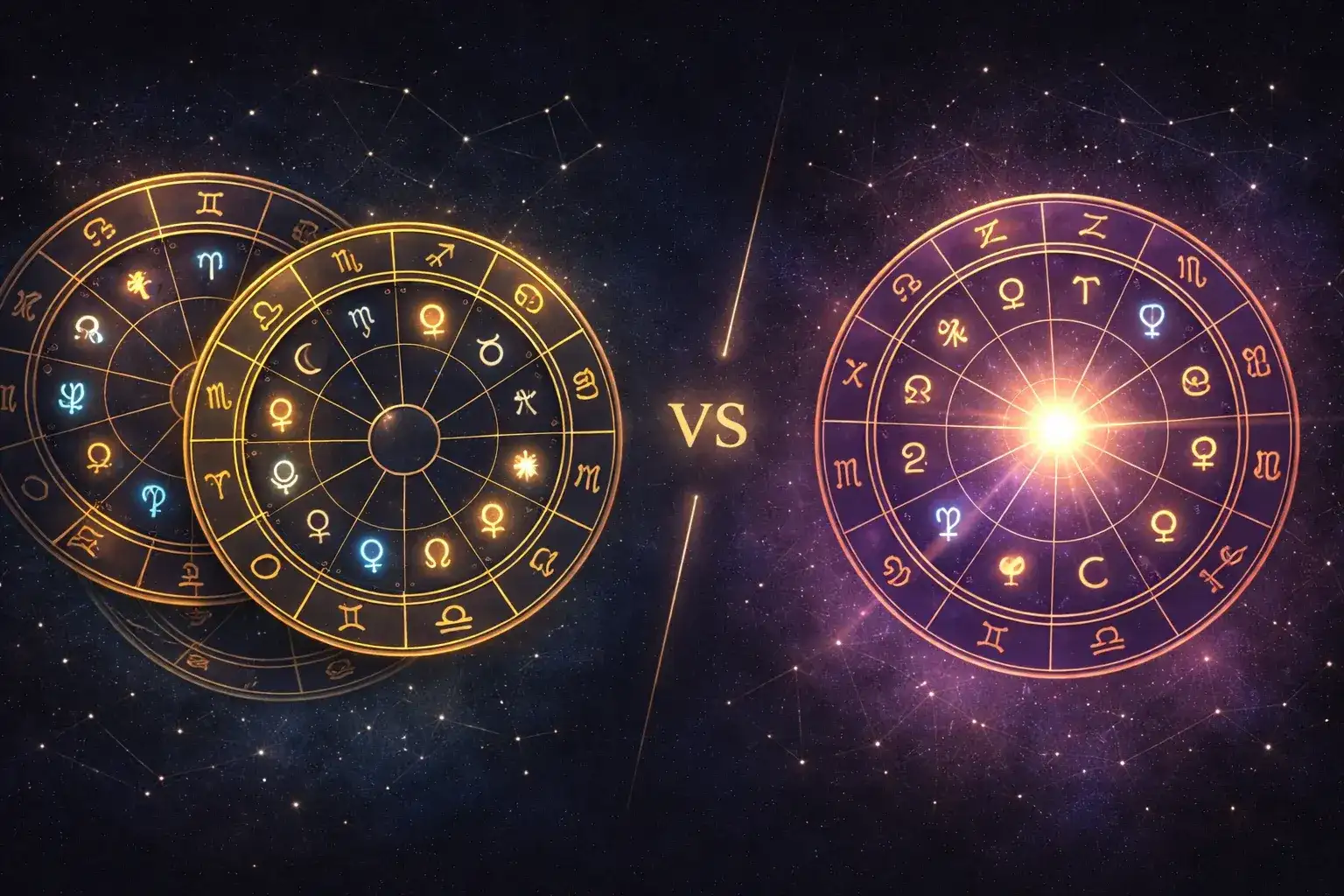
A synastry chart shows how two individuals interact. A composite chart shows what the relationship itself looks like as its own entity. Both are valuable. Neither is complete on its own. And choosing the wrong one for the wrong question leads to readings that feel off.
This guide breaks down the difference, shows you how to read each one, walks through a real celebrity example, and helps you decide which chart to pull up first depending on what you actually want to know.
Create a free synastry chart to follow along with this guide. Open the Synastry Calculator
What Is a Synastry Chart?
A synastry chart places two natal charts on top of each other without merging them. You can see Person A's planets in one color and Person B's planets in another, and you look at the aspects (angles) between them.
It's a dialogue chart. It shows how your Mars talks to their Venus, how your Moon sits relative to their Saturn, where the friction is, where the flow is. The two individuals stay separate — you're reading the conversation between them.
What Synastry Is Best For
- Understanding how two people experience each other
- Identifying areas of attraction, tension, and growth
- Seeing which parts of your chart get activated by a specific person
- Early-stage relationships where you want to understand the dynamic
Synastry answers the question: "What happens when we're in the same room?"
What Is a Composite Chart?
A composite chart takes the mathematical midpoint between every pair of corresponding planets — the midpoint of both Suns, both Moons, both Mercurys, and so on — and plots them as a single chart. The result is one wheel that represents the relationship as its own entity.
The idea, first popularized by John Townley in the 1970s and refined by Robert Hand in Planets in Composite, is that a relationship is more than just two people reacting to each other. It has its own personality, its own needs, its own trajectory. The composite chart maps that.
What the Composite Is Best For
- Understanding the nature of the relationship itself
- Seeing the relationship's strengths, challenges, and purpose
- Long-term relationships where the "we" has become its own thing
- Asking "what is this relationship about?" rather than "how do we affect each other?"
The composite answers: "What does this relationship want to become?"
The Core Difference — Side by Side
This is the comparison every competitor article promises but none of them actually builds into a clear table. Here it is.
| Dimension | Synastry Chart | Composite Chart |
|---|---|---|
| What it maps | Two individuals interacting | The relationship as one entity |
| Number of wheels | Two (overlaid) | One (merged) |
| Calculation method | Direct aspect comparison | Midpoint of each planet pair |
| Best metaphor | A conversation between two people | A portrait of the couple |
| Answers the question | "How do we affect each other?" | "What is this relationship about?" |
| Shows attraction? | Yes — directly | Indirectly |
| Shows long-term purpose? | Partially | Yes — directly |
| Changes over time? | No (natal-based) | No (natal-based) |
| Works for new relationships? | Excellent | Less intuitive |
| Works for long relationships? | Good | Excellent |
| Can be transited? | Not typically | Yes — composite transits are common |
The short version: synastry shows how you relate. The composite shows what you are together. They're not competing tools — they're complementary lenses.
How Each Chart Is Calculated
Understanding the math isn't required, but it sharpens your interpretations.
Synastry: Direct Overlay
No calculation happens between the two charts. You simply place Chart A and Chart B on the same wheel and measure the angles. If your Sun is at 15° Aries and their Moon is at 17° Leo, that's a trine (120° apart, within 2° orb). Done.
The skill is in reading aspect patterns — not in computing anything.
Composite: Midpoint Blending
Every planet pair gets averaged. If your Sun is at 10° Aries and your partner's Sun is at 20° Gemini, the composite Sun sits at 15° Taurus (the zodiacal midpoint). The same calculation runs for every planet, the Ascendant, and the Midheaven.
This creates a chart that neither person "owns." It belongs to the relationship.
What Each Chart Is Best For — By Situation
This is the part most articles skip: practical guidance on which chart to reach for depending on where you are in the relationship.
Dating or Early Relationship (0–6 months)
Use synastry. You're still two individuals feeling each other out. The composite chart will feel abstract because the "we" hasn't fully formed yet. Synastry gives you the immediate, felt dynamics: why the tension, why the pull, why the ease.
Committed Relationship (6 months – 3 years)
Use both. Synastry still matters because you're still learning each other's patterns. But the composite starts to gain traction — you can feel the relationship developing its own rhythm and personality. Read the composite for the big-picture direction and the synastry for the day-to-day texture.
Long-Term or Marriage (3+ years)
Lead with the composite. At this stage, the relationship genuinely is its own entity. Couples start saying "we" more than "I" for good reason — the composite describes that shared identity. Use synastry to troubleshoot specific friction points, but the composite gives you the structural story.
Non-Romantic Relationships
Both work. Synastry is excellent for business partnerships, friendships, parent-child dynamics. The composite works for any relationship that has developed its own character over time. Llewellyn astrologer John Townley originally intended the composite for all relationship types, not just romantic ones.
If you're asking "why does this person affect me this way?" — read the synastry. If you're asking "what is this relationship becoming?" — read the composite.
Reading a Synastry Chart — 5 Focus Areas
If you're already familiar with how to read synastry, this is a quick refresher. If not, start with our complete guide and come back.
1. Sun-Moon Cross-Aspects
The backbone of emotional compatibility. One person's Sun conjunct or trine the other's Moon is one of the strongest indicators of mutual understanding and long-term warmth. More on this in our Sun-Moon soul mate aspect guide.
2. Venus-Mars Aspects
The chemistry axis. Venus-Mars connections drive attraction, desire, and romantic energy. Conjunctions and trines flow easily. Squares create intense, sometimes volatile passion.
3. Saturn Aspects
The glue — or the weight. Saturn aspects between charts bring stability and commitment but also restriction and pressure. Challenging Saturn aspects are common in long-term relationships.
4. House Overlays
Where your partner's planets land in your houses shows which areas of your life they activate. Planets in your 7th house directly impact your partnership experience. Planets in your 12th house stir unconscious material.
5. Outer Planet Contacts
Uranus, Neptune, and Pluto aspects to personal planets create generational or transformative dynamics. They're slow-burn and less about daily interaction, more about deep structural themes.
Reading a Composite Chart — 5 Focus Areas
The composite is read like a natal chart, but for the relationship. Here's where to focus.
1. Composite Sun — The Relationship's Identity
The sign and house of the composite Sun describe what the relationship is about. Composite Sun in the 10th house: the relationship has a public, achievement-oriented identity. Composite Sun in the 4th house: the relationship is anchored in home, family, and private life.
2. Composite Moon — The Emotional Baseline
The composite Moon describes how the relationship feels on a daily basis. Is the emotional default warm and nurturing (Cancer Moon)? Independent and cerebral (Aquarius Moon)? Intense and transformative (Scorpio Moon)?
3. Composite Venus — How Love Is Expressed
Composite Venus shows the relationship's love language. It describes what the couple enjoys together, how they express affection, and what they value as a unit.
4. Composite Saturn — The Relationship's Challenges
Saturn in the composite chart points to the area where the relationship faces its most persistent difficulties. It's also where the most growth happens — if both people are willing. Composite Saturn in the 7th house, ironically, is common in marriages that last.
5. Composite Angles (ASC and MC)
The composite Ascendant is how the relationship presents itself to the outside world. The composite Midheaven is the relationship's public direction or shared ambition. These matter more than most readers expect.
| Composite Planet | What It Represents | Key Question |
|---|---|---|
| Sun | Identity and purpose of the relationship | "What is this relationship about?" |
| Moon | Emotional baseline and daily feeling | "How does being together feel?" |
| Mercury | Communication style as a couple | "How do we talk to each other?" |
| Venus | Love expression and shared values | "What do we enjoy together?" |
| Mars | Shared drive, conflict style | "What motivates us as a team?" |
| Jupiter | Growth areas and shared luck | "Where do we expand together?" |
| Saturn | Challenges, commitment, structure | "What tests us and holds us together?" |
| Ascendant | How others see the relationship | "What do we look like from outside?" |
Real Example — Beyonce and Jay-Z
To make this practical, consider Beyonce (born September 4, 1981, Houston, TX) and Jay-Z (born December 4, 1969, Brooklyn, NY). They've been together since the early 2000s and married in 2008 — a long, public, clearly defined relationship. Perfect for comparing both charts.
Their Synastry
The natal synastry shows a strong Venus-Mars interaction — physical chemistry and romantic attraction are directly wired. Beyonce's Moon aspects Jay-Z's Sun, giving the relationship a deep emotional recognition. But there are also Saturn aspects that bring seriousness and, at times, heaviness. The synastry tells you: this couple clicked hard from the start, but the connection came with weight and responsibility from day one.
Their Composite
The composite chart paints a different picture — or rather, a bigger one. Their composite Sun sits in a position that activates themes of power, legacy, and public identity. The composite Moon suggests an emotionally intense, all-or-nothing baseline. Composite Saturn is prominent, which tracks: this is a marriage that has survived public infidelity, professional competition, and intense media scrutiny.
What Each Chart Reveals That the Other Can't
The synastry explains why they were drawn to each other — the specific planetary hookups that created the spark and the glue. The composite explains what the relationship became — a power partnership with a specific public identity and a shared purpose that extends beyond romance into empire-building.
Neither chart alone tells the full story. Together, they do.
Run a synastry chart and then look at the composite. Compare what each one emphasizes. You'll usually find the synastry matches what you felt early on, and the composite matches what the relationship has evolved into. Generate Your Charts
The Davison Chart — The Third Option Most People Miss
There's a third relationship chart that rarely gets mentioned: the Davison chart (also called the Davison Relationship Chart). Named after astrologer Ronald Davison, it takes a different approach from the composite.
Instead of calculating mathematical midpoints, the Davison chart finds the midpoint in time and space between two births. It calculates the date halfway between both birth dates and the location halfway between both birth places, then casts a chart for that moment and place.
The result is a real astronomical chart — an actual sky that existed — rather than the abstract midpoints of a composite. Some astrologers prefer it for that reason. Others find it less intuitive than the composite.
| Feature | Composite Chart | Davison Chart |
|---|---|---|
| Calculation | Planetary midpoints | Time-space midpoint |
| Astronomically real? | No — abstract midpoints | Yes — real sky at a real moment |
| House system | Can be ambiguous | Clear and standard |
| Popularity | More widely used | Niche but growing |
| Best for | Psychological portrait of the relationship | Seeing the relationship in a "real" chart framework |
In my experience, the composite and Davison charts often tell very similar stories. If you're just getting started, the composite is the standard and the one most resources cover. If you want to explore further, try the Davison as a cross-reference.
Common Mistakes
Treating synastry and composite as the same thing. They measure different dimensions of the relationship. Reading one doesn't replace reading the other.
Only reading the composite for new relationships. The composite describes potential that hasn't been activated yet. Early on, synastry is usually more felt and more immediately useful.
Ignoring composite house placements. Many readers focus only on the planets and aspects in the composite, skipping the houses. The composite Sun's house placement is arguably the single most important thing in the chart.
Panicking over a "bad" composite chart. A composite chart with lots of squares and Saturn contacts doesn't mean a doomed relationship. It means the relationship has structure, challenges, and growth potential. Many lasting marriages have difficult composite charts — the difficulty is what gives the relationship depth.
Forgetting that both charts are static. Neither synastry nor the composite shows how the relationship evolves over time. For that, you need progressed synastry or solar return synastry.
Frequently Asked Questions
Which is more accurate — synastry or composite?
Neither is more accurate. They measure different things. Synastry measures the interaction between two people. The composite measures the nature of the relationship entity. Asking which is more accurate is like asking whether a thermometer or a barometer is more accurate — they measure different weather dimensions.
Can I use a composite chart for a friendship?
Yes. Composite charts work for any relationship that has its own identity — friendships, business partnerships, parent-child relationships, creative collaborations. The chart describes the relationship, regardless of its type.
How is a composite chart different from a Davison chart?
A composite chart calculates the midpoint between each planet pair — it's mathematically constructed. A Davison chart finds the midpoint in time and space between two births and casts a real chart for that moment. Both describe the relationship, but from slightly different angles.
Do I need birth times for both charts?
For synastry, you can get useful information without exact birth times (you lose house overlays but keep planetary aspects). For a composite chart, birth times are more important because the composite Ascendant and house placements are central to interpretation. Without times, composite readings are incomplete.
What if our synastry looks great but our composite looks terrible?
This happens more often than you'd think. Strong synastry with a challenging composite often describes a couple with fantastic chemistry who struggle with the relationship as a shared project. The attraction is real, but the "we" takes work. That's not a death sentence — it's information.
Should I read synastry or composite first?
Start with synastry. It's more intuitive, more immediately felt, and gives you the ground-level experience of the relationship. Once you understand the dynamic between the two individuals, the composite adds context about where the relationship is headed as its own entity.
Use Both — They're Complementary
Synastry and composite charts aren't rivals. They're two views of the same relationship, taken from different altitudes. Synastry is street-level — the eye contact, the arguments, the chemistry. The composite is aerial — the shape of the thing, its direction, its meaning.
For a full reading, you need both. Start with the synastry to understand the people. Move to the composite to understand the partnership — our free composite chart calculator builds it from two birth details and reads the composite Sun, Moon and tightest aspect for you. And if you want to see how all of it evolves over time, layer on progressed synastry and solar return synastry.
Generate your free synastry chart and see how your planets interact. Then compare it to the composite picture. Create Your Synastry Chart · Calculate Your Composite Chart
Disclaimer: Synastry, composite, and all astrological interpretations in this article are for reflection and self-understanding only. They should not be used as the sole basis for relationship decisions. Astrology offers one lens — your lived experience offers another.
Author

Categories
More Posts

Moon Lines: Finding Your Emotional Home in Astrocartography
Discover where your Moon lines can help you find emotional nurturing, healing, and a true sense of home. Learn about all four Moon lines and their unique gifts.

Solar Return Synastry: Your Year-by-Year Relationship Forecast
Discover how solar return synastry reveals what each year brings to your relationship. Complete guide with step-by-step reading, real examples, and free calculator.

Sun-Moon Connections: The Soul Mate Aspect in Synastry
Discover why Sun-Moon aspects are considered the ultimate soulmate connection in astrology. Learn about all six aspects and what they mean for your relationship.