
Solar Return Synastry: Your Year-by-Year Relationship Forecast
Discover how solar return synastry reveals what each year brings to your relationship. Complete guide with step-by-step reading, real examples, and free calculator.
Your birthday just passed. You blew out the candles, ate the cake, posted the photo, moved on. Meanwhile, the sky quietly reset a clock that astrologers have been tracking for over two thousand years.
That clock is your solar return — the exact moment each year when the Sun returns to the precise degree it occupied when you were born. The chart cast for that moment becomes a kind of annual weather report for your life. And when you overlay your solar return chart against your partner's, you get something most astrology sites still don't offer: a year-by-year relationship forecast based on where both of you actually are right now.
This guide covers everything you need to read a solar return synastry chart from scratch — what it is, how to build one, what to look for, and how to tell whether the year ahead is bringing your relationship closer together or pulling it into new territory.
Cast your free synastry chart and keep it open while you read. You'll want both birth charts handy for comparison. Open the Synastry Calculator
What Is a Solar Return Chart?
A solar return (SR) chart is cast for the exact second the transiting Sun returns to your natal Sun's degree and minute. This happens once a year, usually on or within a day of your birthday. The chart drawn for that moment — using your current location — becomes a snapshot of the year ahead.
The Birthday Chart — One Year, One Snapshot
Think of it as a temporary birth chart that lasts exactly twelve months. The houses, the rising sign, the Moon placement — all of it applies only from this birthday to the next. Then the slate wipes clean and a new SR chart takes over.
Astrologers have used solar returns since at least the Persian tradition of Abu Ma'shar in the 9th century. The technique survived because it works at a practical level: the SR chart describes the themes, moods, and pressure points of a given year with surprising consistency.
What It Does (and Doesn't) Predict
A solar return chart does not predict specific events. It won't tell you that you'll get engaged on March 14th or break up in August. What it does is describe the emotional and situational climate of the year — which areas of life are active, which planets are loud, and where friction or ease is likely to show up.
Solar return charts are not destiny maps. They describe weather, not fate. A difficult SR year doesn't doom you any more than a rainy forecast ruins a wedding — it just tells you to bring an umbrella.
What Is Solar Return Synastry?
Solar return synastry takes the technique one step further. Instead of reading your SR chart in isolation, you overlay it against another person's chart — either their natal chart or their own solar return for the same year.
This lets you answer a question that regular synastry can't touch: what does this specific year look like for us?
Overlaying Two Solar Returns
Regular synastry compares two natal charts. The aspects it finds are permanent — they describe the underlying chemistry that exists whether the couple has been together for two weeks or twenty years. That's useful, but it's also static.
Solar return synastry is dynamic. The aspects change every year because each person gets a fresh SR chart on their birthday. A couple might have a warm, Venus-heavy SR synastry in 2025 and a tense, Saturn-heavy one in 2026. Neither cancels the other out. They're seasonal.
Why Regular Synastry Isn't Enough for Timing
If you've ever wondered "our natal synastry looks great, so why is this year so hard?" — solar return synastry is probably the missing layer. Natal synastry shows the foundation. SR synastry shows what's being built on that foundation this year.
| Technique | What It Answers | Timeframe |
|---|---|---|
| Natal Synastry | "What's the core chemistry between us?" | Permanent |
| Solar Return Synastry | "What does this year look like for us?" | 12 months |
| Progressed Synastry | "How are we both evolving over time?" | Years to decades |
| Transit Synastry | "What's pressing on us this week?" | Days to weeks |
Each layer tells a different part of the story. For relationship timing — when things shift, when opportunities open — SR synastry is the sharpest tool.

Three Ways to Run a Solar Return Synastry
There isn't just one version of SR synastry. You can overlay charts three different ways, and each one answers a slightly different question.
Method 1 — Your SR Chart Over Partner's Natal Chart
You place your current-year solar return planets on top of your partner's birth chart. This shows what your current year activates in their chart. If your SR Venus lands in their 7th house, you're bringing romantic energy into their partnership zone this year.
Best for: understanding your impact on the relationship this year.
Method 2 — Partner's SR Chart Over Your Natal Chart
The reverse. Their SR planets land in your houses. If their SR Saturn falls on your natal Moon, expect a year where their responsibilities or emotional caution weighs on your feelings.
Best for: understanding what they're bringing to you this year.
Method 3 — Both SR Charts Overlaid
You compare both solar return charts against each other — no natal charts involved. This gives you a pure snapshot of the year's relationship energy, separate from the permanent natal foundation.
Best for: reading the "now" of the relationship. This is where I recommend most people start.
If you're new to SR synastry, begin with Method 3 — both solar returns compared. It's the most intuitive and gives you the broadest picture. Methods 1 and 2 add depth once you're comfortable with the basics.
How to Read a Solar Return Synastry Chart — 7 Steps
Here's the process I follow when reading an SR synastry for a couple. Each step builds on the last.
Step 1 — Cast Both Solar Return Charts for the Same Year
Generate each person's solar return chart for the year you want to examine. Use the location where each person actually was on their birthday — not their birth city. The SR location matters because it sets the houses.
Step 2 — Check the SR Ascendant and Its Ruler
The solar return Ascendant sets the tone of the entire year for each person. Note the sign and the house placement of its ruling planet. If one partner's SR Ascendant is in Libra (partnership-focused) while the other's is in Capricorn (career-focused), you already know something about where each person's energy is pointed this year.
Step 3 — Find Venus and Mars in Both SR Charts
Venus tells you where love, pleasure, and social energy land this year. Mars tells you where drive, desire, and potential conflict land. Write down the sign, house, and any major aspects for both planets in both charts.
Step 4 — Examine the 5th and 7th House Rulers
The 5th house rules romance and dating. The 7th house rules committed partnership. Check both houses in both SR charts: are they occupied? What sign is on the cusp? Where is the ruling planet, and what aspects does it make?
Step 5 — Look for Cross-Chart Aspects
Now overlay the two charts. This is where the actual synastry lives. Look for conjunctions, trines, squares, and oppositions between planets in Chart A and planets in Chart B. Tight orbs only — 2° maximum for SR synastry.
Step 6 — Note Planets in Angular Houses (1st, 4th, 7th, 10th)
Planets in angular houses are the loudest voices in any chart. If your partner's SR Mars falls in their 7th house, partnership is going to demand action this year. If your SR Jupiter is in your 4th house, home and family expansion is a strong theme.
Step 7 — Compare to the Natal Synastry Baseline
Pull up the natal synastry chart you already have. Ask: does this year's SR synastry echo the natal themes, or does it introduce something new? An SR year that repeats natal patterns tends to feel familiar. An SR year that contradicts them feels like unfamiliar territory — not bad, just different.
The 7th House in Solar Return — The Relationship Weather Vane
If there's one part of the SR chart that relationship-focused readers gravitate toward, it's the 7th house. Fair enough — it's the house of partnership. But reading it correctly requires some nuance.
Empty 7th House ≠ No Relationship
An empty 7th house in a solar return does not mean the relationship disappears. It means the relationship isn't the primary theme of the year. The partnership is still there — it just isn't where the loudest action is happening.
Benefics vs Malefics in the 7th
Having Jupiter or Venus in the SR 7th house generally warms partnership energy for the year. Saturn or Mars in the 7th doesn't ruin anything, but it brings weight: responsibility, confrontation, hard conversations, or structural changes to the partnership.
7th House Ruler's Condition
The planet that rules the 7th house cusp sign matters more than what's sitting inside the house. Check where that ruler is by house and sign, and what aspects it makes. A well-aspected 7th ruler in the 5th house, for example, suggests the partnership gets a romantic, playful boost this year.
| SR 7th House Planet | What It Typically Signals for the Year |
|---|---|
| Sun | Partnership becomes a central identity theme |
| Moon | Emotional needs get channeled through the relationship |
| Venus | Harmony, affection, social enjoyment with partner |
| Mars | Increased passion but also potential for conflict |
| Jupiter | Growth, generosity, expansion in the partnership |
| Saturn | Commitment tests, responsibility, maturation |
| Uranus | Sudden changes, desire for freedom, unconventional dynamics |
| Neptune | Idealization, spiritual connection, or confusion |
| Pluto | Power dynamics surface, deep transformation |
| North Node | Fateful encounters or relationship turning points |
Venus and Mars in Solar Return Synastry
If the 7th house is the weather vane, Venus and Mars are the wind and the fire. Together they describe where love lands and where desire ignites for the year.
Venus Sign + House — Where Love Lands This Year
The SR Venus sign tells you how someone gives and receives affection this year. SR Venus in Cancer loves through nurturing and domesticity. SR Venus in Aquarius loves through friendship and intellectual stimulation. The house placement tells you where — which life area gets the sweetness.
Mars Sign + House — Where Passion Fires Up
SR Mars describes what a person actively pursues this year and how they assert themselves. In synastry, check where one person's SR Mars falls in the other's SR chart. Mars in someone's 1st house brings direct, sometimes confrontational energy. Mars in the 5th house brings heat and creative sparks.
Venus-Mars Cross-Aspects Between Two SR Charts
When one person's SR Venus aspects the other's SR Mars (or vice versa), physical attraction gets a year-long spotlight. Trines and sextiles keep it playful. Squares and oppositions make it intense and a little volatile.
| Your SR Venus in Partner's SR House | The Love Theme for the Year |
|---|---|
| 1st House | Strong personal attraction; they find you magnetic |
| 4th House | Domestic warmth; nesting energy together |
| 5th House | Romance, play, creative expression as a couple |
| 7th House | Direct partnership focus; commitment conversations |
| 8th House | Deep intimacy; shared finances or vulnerability |
| 10th House | Public-facing couple energy; supporting each other's ambitions |
| 12th House | Private, spiritual connection; possible hidden tensions |
Real Example — Taylor Swift & Travis Kelce, 2023
To ground this in something concrete, consider Taylor Swift (born December 13, 1989, West Reading, PA) and Travis Kelce (born October 5, 1989, Westlake, OH). Their relationship went public in July 2023, when Taylor attended her first Kansas City Chiefs game.
Travis's 2022 Solar Return (October 5, 2022 — his birthday chart for the year ahead): Venus was active and well-aspected, sitting in a position that energized his 5th house of romance. His SR 7th house ruler was receiving a Jupiter trine — expansion and luck in partnership.
Taylor's 2022 Solar Return (December 13, 2022): Her SR chart featured a prominent Venus-Jupiter connection as well, with strong 5th house activation. Both charts were independently broadcasting "romance" as a headline theme for 2023.
The SR Synastry between them: When you overlay both solar return charts, Taylor's SR Venus formed a trine to Travis's SR Mars — a textbook attraction aspect. Their SR Moons were in compatible elements, suggesting emotional ease from the start. The cross-chart 7th house activity was unusually strong for two people who technically hadn't met yet when these charts were cast.
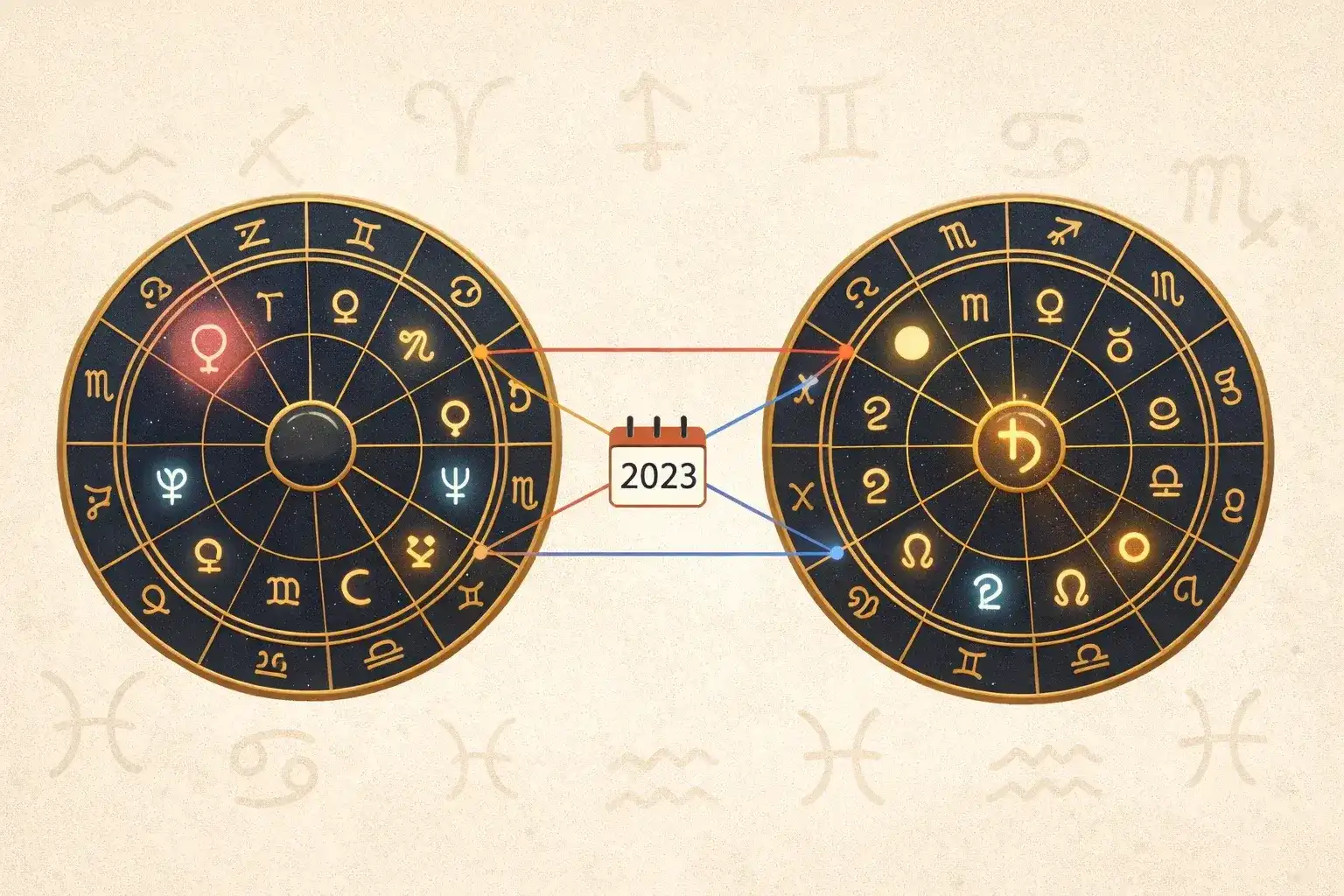
The point isn't that the charts "predicted" the relationship. It's that both individuals' SR charts were primed for romance in the same year, and the SR synastry between them showed above-average compatibility for that specific twelve-month window. A year earlier or later, the SR synastry would look different.
Pick the year you met your partner, or a year that felt pivotal. Cast both solar return charts for that year and overlay them. You'll often find the SR synastry mirrors exactly what you were living through. Generate Your Charts
Year-Over-Year Tracking — Reading SR Synastry Across Multiple Years
One SR synastry reading is a snapshot. Multiple years side by side is a film.
The "Three-Year Window" for Major Relationship Shifts
Astrologer and researcher PlutonicDesire proposes a useful rule of thumb: a major relationship theme needs to appear in at least three separate timing techniques (SR, progressions, transits) before you should take it seriously. I'd add a time-based corollary: if the same SR synastry theme shows up three years running, it's not a passing season — it's a structural change.
For example, if Saturn keeps appearing in the SR 7th house or forming hard aspects in the SR synastry year after year, the relationship is being asked to mature or confront something persistent. One year of Saturn is a test. Three consecutive years is a renovation.
When SR Themes Repeat the Natal Synastry
Pay attention when an SR synastry aspect mirrors a natal synastry aspect. If the natal synastry already has a Venus-Mars trine and the SR synastry for 2026 also shows a Venus-Mars trine, that year amplifies the existing attraction. It's like the volume knob turning up on a song that was already playing.
Solar Return Location — Does It Matter for Synastry?
The short answer: yes, but less than people think.
Relocated Solar Returns
Some astrologers cast the SR chart for a different location than where the person actually was — a technique called relocated solar return. The idea is that you can "choose" a more favorable chart by being in a specific city on your birthday. The planets don't change, but the houses do.
For synastry purposes, I recommend sticking with the actual location. The relocated technique has value for individual readings, but when you're comparing two people's SR charts, using the real locations gives you a more honest picture.
When Partners Are in Different Cities on Their Birthday
This happens often. One partner celebrates in New York, the other in London. Each person's SR chart reflects their own birthday location — that's fine. The synastry overlay still works because you're comparing planetary positions and aspects, which don't change with location. Only the house cusps differ.
Common Mistakes
Only reading your own SR chart. Solar return synastry requires both charts. Your year might look romantic, but if your partner's SR is dominated by career and isolation themes, the experience won't match your expectations.
Confusing SR with transits. Transits describe what's happening in the sky right now relative to your natal chart. A solar return chart is a fixed snapshot for the year. They overlap but they're different techniques — don't mix the two in the same reading.
Ignoring the SR Ascendant. The rising sign of the SR chart colors everything else. Skipping it is like reading a book starting at chapter three.
Over-reading empty houses. An empty 5th house doesn't mean no romance. An empty 7th house doesn't mean no partnership. It means those areas aren't the primary stage for the year's drama. The action is elsewhere.
Frequently Asked Questions
Can a solar return chart predict marriage?
Not with certainty. What it can show is a year where partnership themes are unusually active — Venus or Jupiter in the 7th house, strong 5th-to-7th house connections in the SR synastry. These signatures are common in years when commitment deepens, but they also appear in years when someone simply enters a meaningful relationship without formalizing it.
Should I relocate for a better solar return?
This is debated. Some traditional astrologers swear by it. Others — including me — think the benefits are overstated for synastry. You can change your SR houses by relocating, but you can't change the planetary aspects, and aspects do most of the heavy lifting in synastry readings.
How far in advance can I read a solar return synastry?
You can cast future SR charts for any year. However, the further out you go, the less useful it becomes — your life circumstances change, and the context that makes SR interpretation meaningful won't exist yet. I typically don't read more than two years ahead.
Do both partners need exact birth times?
For a full reading with house placements, yes. Without birth times, you can still compare SR planetary signs and aspects, but you lose the house overlays — which are arguably the most useful part of SR synastry. If only one person has an exact birth time, use Method 1 or 2 (SR over natal) with that person's natal chart.
What if our solar returns have no aspects to each other?
It happens. Some years the two SR charts simply don't talk to each other. That doesn't mean the relationship is in trouble — it means the relationship isn't the primary theme for either person that year. Both people might be focused on career, health, or personal projects. The natal synastry still holds the baseline.
How is solar return synastry different from a composite chart?
A composite chart blends two natal charts into one "relationship chart." A solar return synastry compares two separate SR charts without merging them. The composite shows the relationship as an entity. SR synastry shows how two individuals' current years interact. They complement each other — use both for a complete picture.
Start Reading the Year Ahead
Your birthday isn't just a celebration. It's a reset point — and when you compare that reset against your partner's, you get a forecast that no other timing technique can match.
Pull up both solar return charts, look for the Venus and Mars cross-aspects, check the 7th house, and compare it all against your natal synastry baseline. That's the year you're walking into together.
Generate both charts in under a minute. All you need is two birth dates, times, and locations. Open the Calculator
Disclaimer: Solar return synastry and all astrological interpretations in this article are for reflection and self-understanding only. They are not predictions of future events, and they should not be used as the sole basis for relationship decisions. Astrology describes symbolic patterns — it does not determine outcomes.
Author

Categories
More Posts

Complete Guide to Reading a Synastry Chart
Learn how to read and interpret synastry charts. Understand planetary aspects, house overlays, and what they mean for your relationship compatibility.

Complete Guide to Reading Your Astrocartography Map
Learn how to read your astrocartography map and discover which locations around the world activate different planetary energies in your life.

Venus-Mars Aspects in Synastry: The Ultimate Guide to Magnetic Chemistry
Discover how Venus-Mars aspects create intense attraction and chemistry in relationships. Learn about conjunctions, trines, squares, and more.