
Understanding Challenging Saturn Aspects in Synastry
Learn how to work with difficult Saturn aspects in relationships. Discover why Saturn is the cosmic glue that holds long-term partnerships together.
Few planets inspire as much fear in synastry as Saturn. Mention 'Saturn square Venus' or 'Saturn opposite Moon' and even experienced astrologers may wince. Saturn aspects have earned a reputation as relationship killers—cold, restrictive, and burdensome. But is this reputation deserved?
The truth is more nuanced. Yes, challenging Saturn aspects can feel heavy and demanding. But they're also the cosmic glue that holds long-term relationships together. Without Saturn, relationships may sparkle but lack staying power. In this guide, we'll explore what makes Saturn aspects challenging, how they manifest with each personal planet, and most importantly—how to make them work for your relationship.
"Saturn is the glue that binds couples through the years. No matter how deep the love, it is Saturn that tells us whether the relationship has the potential to be truly long-lasting."
Calculate your free synastry chart and discover what Saturn connections exist between you and your partner.
What Saturn Represents in Synastry
Saturn is the planet of time, responsibility, boundaries, commitment, and karmic lessons. In synastry, it shows where the relationship gets tested—and what must be built slowly, with patience and effort. Saturn aspects are rarely casual; they tend to feel binding, serious, and sometimes inescapable.
Healthy Saturn Energy: Structure, loyalty, reliability, commitment, maturity, realistic expectations, building together over time, teaching and learning from each other.
Unhealthy Saturn Energy: Criticism, control, coldness, emotional scarcity, "love must be earned" dynamics, fear of change, rigidity, parental/authority projection.
The key difference? Healthy Saturn supports growth while providing stability. Unhealthy Saturn restricts, criticizes, and makes love feel conditional. Which expression shows up depends largely on the Saturn person's relationship with their own natal Saturn.
Why Saturn Aspects Feel Difficult
One of Saturn's trickiest qualities is its timing. Saturn problems rarely appear during the honeymoon phase. When you're dating and infatuated, Saturn stays hidden. It's only when you commit—move in together, get married, sign the mortgage—that Saturn's challenges emerge.
This is why so many couples are blindsided. The relationship felt easy before, so why is it suddenly hard? The answer is Saturn. As the relationship becomes more 'real,' Saturn's tests begin. The Saturn person may become more critical, controlling, or emotionally distant. The personal planet person may feel stifled, judged, or unable to grow.
Saturn aspects don't show their full colors until you commit. If your relationship suddenly felt harder after moving in together, getting engaged, or having children, Saturn may be at work. This isn't a sign to leave—it's a sign to consciously work with Saturn's energy.
The Challenging Aspects Explained
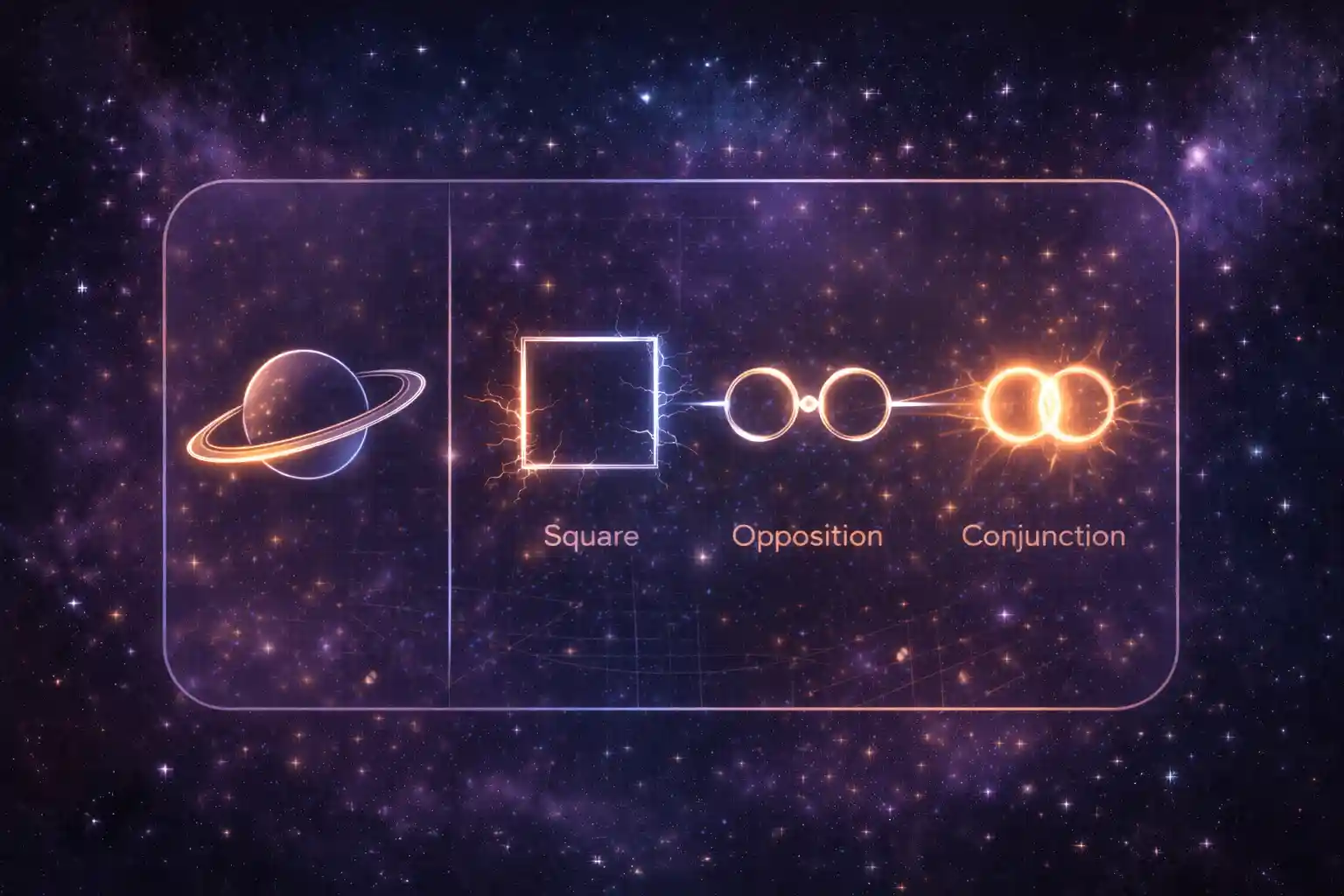
While all Saturn aspects require conscious effort, squares and oppositions are considered the most challenging. Here's what each difficult aspect looks like:
Saturn Square: The Friction Point
How It Feels: Constant tension and judgment Main Challenge: Criticism, control, feeling stifled Growth Potential: Building resilience, learning boundaries
The most friction-heavy Saturn aspect. There's a persistent sense of not being good enough, of being criticized or limited by the Saturn person.
Squares create ongoing tension that demands attention. The Saturn person may feel responsible for 'fixing' or 'improving' the other, while the personal planet person feels constantly evaluated and found wanting. Arguments may follow similar patterns, with Saturn falling into lecturing mode and the other feeling dismissed. The gift? If you can work through it, you build incredible resilience and truly earn each other's respect.
Saturn Opposition: The Power Struggle
How It Feels: Push-pull, see-saw dynamic Main Challenge: Power imbalance, feeling restricted Growth Potential: Finding balance, mutual respect
A magnetic but polarizing connection. One person feels limited while the other feels burdened with responsibility.
Oppositions create a see-saw dynamic where one person embodies Saturn (serious, responsible, mature) and the other embodies the personal planet (expressive, youthful, spontaneous). There may be an obvious age, status, or power difference. The Saturn person can feel like a parent, teacher, or authority figure—which may feel comforting at first but becomes suffocating over time. The key is consciously sharing both roles rather than getting locked into one.
Saturn Conjunction: The Binding Force
How It Feels: Heavy, karmic, inescapable Main Challenge: Intensity, seriousness, burden Growth Potential: Deep commitment, karmic healing
The most binding Saturn aspect. There's a profound sense of fate or karma—for better or worse, this connection feels significant and unavoidable.
Conjunctions merge Saturn's energy directly with a personal planet, creating an intensely serious dynamic. The relationship feels 'meant to be,' but also heavy with responsibility. The Saturn person takes commitment seriously—perhaps too seriously—and may dampen the other's natural expression. However, with consciousness, this aspect can provide incredible stability and loyalty. These couples often stay together through thick and thin.
Saturn Aspects to Personal Planets
Saturn expresses differently depending on which personal planet it aspects. Here's what to expect with each:
Saturn-Sun: The Dimmed Light
With challenging Saturn-Sun aspects, the Sun person may feel like their light doesn't shine as bright around the Saturn person. Saturn can unconsciously criticize, dampen enthusiasm, or make the Sun feel like they need to be more serious, responsible, or 'grown up.' Over time, the Sun person may become resentful, feeling that they can't fully be themselves.
Saturn sees the Sun and thinks 'you could be better if you just...' The Sun feels perpetually evaluated. With awareness, Saturn can become a supportive mentor rather than a critical parent.
Saturn-Moon: The Emotional Freeze
Perhaps the most emotionally challenging Saturn aspect. The Moon person's emotional needs, vulnerabilities, and nurturing instincts meet Saturn's coldness, criticism, or emotional withholding. The Moon may feel their feelings are unwelcome, childish, or 'too much.' Emotional intimacy becomes difficult.
Saturn-Moon aspects require extra emotional awareness. The Moon person needs their feelings validated, not corrected. The Saturn person needs to examine whether they're projecting their own emotional fears onto their partner.
Saturn-Venus: The Love Barrier
Love meets limitation. With challenging Saturn-Venus aspects, there are barriers to affection—whether physical distance, coldness, or a sense that love must be 'earned.' The Venus person may feel unloved or that their romantic gestures are rejected. The Saturn person may struggle to express warmth or may use love as a reward for 'good behavior.'
Often, Saturn-Venus challenges stem from Saturn's fear of vulnerability. If Saturn can soften and Venus can be patient, this aspect can actually build incredibly loyal, lasting love—just not the easy, effortless kind.
Saturn-Mars: The Clash of Wills
Fire meets ice. Mars is hot, impulsive, and action-oriented. Saturn is cold, cautious, and restraining. When these planets clash, there's often competition, frustration, and resentment. Saturn may try to control Mars's energy, while Mars feels constantly blocked or criticized for their drive and desires.
Saturn-Mars aspects can escalate into genuine power struggles or chronic frustration. If you find yourselves competing rather than cooperating, this aspect needs conscious attention. Healthy outlets for Mars's energy are essential.
Saturn-Mercury: The Silenced Voice
Communication becomes heavy. The Mercury person may feel judged, interrupted, or intellectually dismissed by Saturn. Their ideas are labeled impractical, naive, or immature. Saturn's tone may feel patronizing or lecturing. Over time, Mercury may simply stop sharing ideas, leading to withdrawal and resentment.
The solution is creating judgment-free space for Mercury to express themselves. Saturn needs to listen without correcting. Mercury needs to share needs directly rather than expecting Saturn to intuit them.
Saturn Aspects: Quick Reference
| Aspect | How It Feels | Main Challenge | Growth Potential |
|---|---|---|---|
| Saturn Square | Constant tension and judgment | Criticism, control, feeling stifled | Building resilience, learning boundaries |
| Saturn Opposition | Push-pull, see-saw dynamic | Power imbalance, feeling restricted | Finding balance, mutual respect |
| Saturn Conjunction | Heavy, karmic, inescapable | Intensity, seriousness, burden | Deep commitment, karmic healing |
The Gift Within the Challenge
Despite their difficulties, Saturn aspects offer genuine gifts for those willing to work with them:
- Karmic lessons and soul growth — Saturn connections often indicate past-life ties and unfinished business that, when resolved, brings profound evolution.
- The 'glue' for long-term commitment — Relationships with strong Saturn aspects often last through challenges that would break apart Saturn-less relationships.
- True stability and reliability — Once Saturn's tests are passed, the relationship becomes rock-solid. You know you can count on each other.
- Mature, realistic love — Saturn strips away fantasy and projection, leaving love that's based on who you really are, not idealized images.
- Deep mutual respect — Couples who successfully navigate Saturn challenges develop respect that comes only from working through genuine difficulty together.
When Saturn Goes Wrong
Saturn aspects become truly problematic when the Saturn person hasn't done their own inner work. If someone has a difficult relationship with their natal Saturn—unresolved authority issues, fear of vulnerability, rigid expectations from childhood—they'll project these issues onto their partner.
Myth: "Saturn aspects always mean the relationship is doomed."
Reality: Many of the longest, most stable marriages have challenging Saturn aspects. Saturn provides staying power. The question isn't whether you have Saturn aspects, but whether you're willing to do the growth work they demand.
Myth: "The Saturn person is always the 'bad guy.'"
Reality: Saturn people often feel burdened by a sense of responsibility they didn't ask for. They may be projecting their own fears, but they're not villains. Both partners contribute to Saturn dynamics, and both must participate in healing them.
Making Saturn Aspects Work
Challenging Saturn aspects aren't curses—they're invitations to do relationship work consciously. Here's how to navigate them:
1. Name the Dynamic
Awareness is the first step. Recognize when Saturn patterns are playing out: criticism, control, coldness, or feeling 'not enough.' Name it out loud: "I think Saturn is showing up right now."
2. Saturn Person: Check Yourself
If you're the Saturn person, regularly examine your motivations. Are you offering helpful guidance or projecting your fears? Are you supporting growth or trying to control? Honest self-reflection is essential.
3. Personal Planet Person: Speak Up
Don't silently accept criticism or limitation. Express your needs clearly. Tell your partner when you feel judged or stifled. Resentment builds when needs go unvoiced.
4. Create Growth Space
Saturn fears change, but relationships require it. Actively create space for both partners to evolve. Celebrate growth rather than fearing it. The relationship should enhance you, not limit you.
5. Appreciate the Stability
Don't only focus on what's hard. Acknowledge what Saturn provides: reliability, commitment, showing up even when it's difficult. These qualities become more precious over time.
Saturn Doesn't Equal Doom
Here's the perspective many astrologers miss: you rarely see long-lasting relationships without significant Saturn contacts. Saturn provides the structure that helps relationships survive challenges, transitions, and the inevitable changes of life. Without Saturn, relationships may be exciting but fragile.
"The existence of a challenging Saturn aspect doesn't doom your relationship—it simply makes it more real and meaningful, the longer you keep learning from it."
The question isn't whether you have Saturn aspects, but whether you're both committed to growing through them. With awareness, communication, and mutual respect, Saturn becomes the foundation that supports love through decades—not the force that destroys it.
Embracing Saturn, the Cosmic Teacher
Saturn in synastry is ultimately about growth through relationship. It asks: Can you love someone while accepting their imperfections? Can you commit even when it's hard? Can you build something lasting rather than chasing perpetual excitement?
If your synastry chart shows challenging Saturn aspects, don't despair. You've been given an opportunity for profound relationship growth. The couples who navigate Saturn successfully often have the deepest, most respectful, most enduring partnerships. Your Saturn aspects are not obstacles—they're invitations to build love that lasts.
Calculate your free synastry chart and discover all the Saturn aspects between you and your partner.
Disclaimer: Astrological interpretations are for entertainment and self-reflection purposes only. Challenging aspects don't determine relationship outcomes—communication, respect, and conscious effort do. If you're experiencing serious relationship difficulties, consider working with a qualified therapist or counselor.
Author

Categories
More Posts

Sun-Moon Connections: The Soul Mate Aspect in Synastry
Discover why Sun-Moon aspects are considered the ultimate soulmate connection in astrology. Learn about all six aspects and what they mean for your relationship.

Moon Lines: Finding Your Emotional Home in Astrocartography
Discover where your Moon lines can help you find emotional nurturing, healing, and a true sense of home. Learn about all four Moon lines and their unique gifts.

Venus-Mars Aspects in Synastry: The Ultimate Guide to Magnetic Chemistry
Discover how Venus-Mars aspects create intense attraction and chemistry in relationships. Learn about conjunctions, trines, squares, and more.