
Complete Guide to Reading a Synastry Chart
Learn how to read and interpret synastry charts. Understand planetary aspects, house overlays, and what they mean for your relationship compatibility.
Have you ever wondered why you feel an instant connection with some people while others seem to rub you the wrong way from the start? The answer might be written in the stars. Synastry, the art of comparing two birth charts, offers profound insights into relationship dynamics that can help you understand your connections on a deeper level.
In this comprehensive guide, we'll walk you through everything you need to know about reading a synastry chart—from understanding the key planets and aspects to interpreting what they mean for your relationship. Whether you're curious about a romantic partner, a friend, or even a business associate, synastry can reveal the cosmic blueprint of your connection.
Generate your free synastry chart now and follow along with this guide. Create Free Synastry Chart
What is a Synastry Chart?
A synastry chart is created by overlaying two birth charts on top of each other. This allows astrologers to see how the planets in one person's chart interact with the planets in another person's chart. These interactions, called aspects, reveal areas of harmony, tension, attraction, and growth potential in the relationship.
Unlike a single birth chart that describes your individual personality and life path, a synastry chart specifically shows the dynamic energy exchange between two people. It's like having a cosmic roadmap of your relationship.
Think of synastry as the chemistry between two people translated into astrological language. It doesn't predict whether a relationship will succeed or fail—it illuminates the terrain you'll navigate together.
What You Need Before Starting
To create an accurate synastry chart, you'll need birth information for both people:
- Birth date (day, month, year) for both individuals
- Birth time (as precise as possible) for both individuals
- Birth location (city and country) for both individuals
The exact birth time determines the Ascendant (Rising sign) and house placements, which are crucial for synastry. If you don't have an exact time, you can still get valuable insights, but some details may be less accurate.
The Key Players: 5 Essential Planets
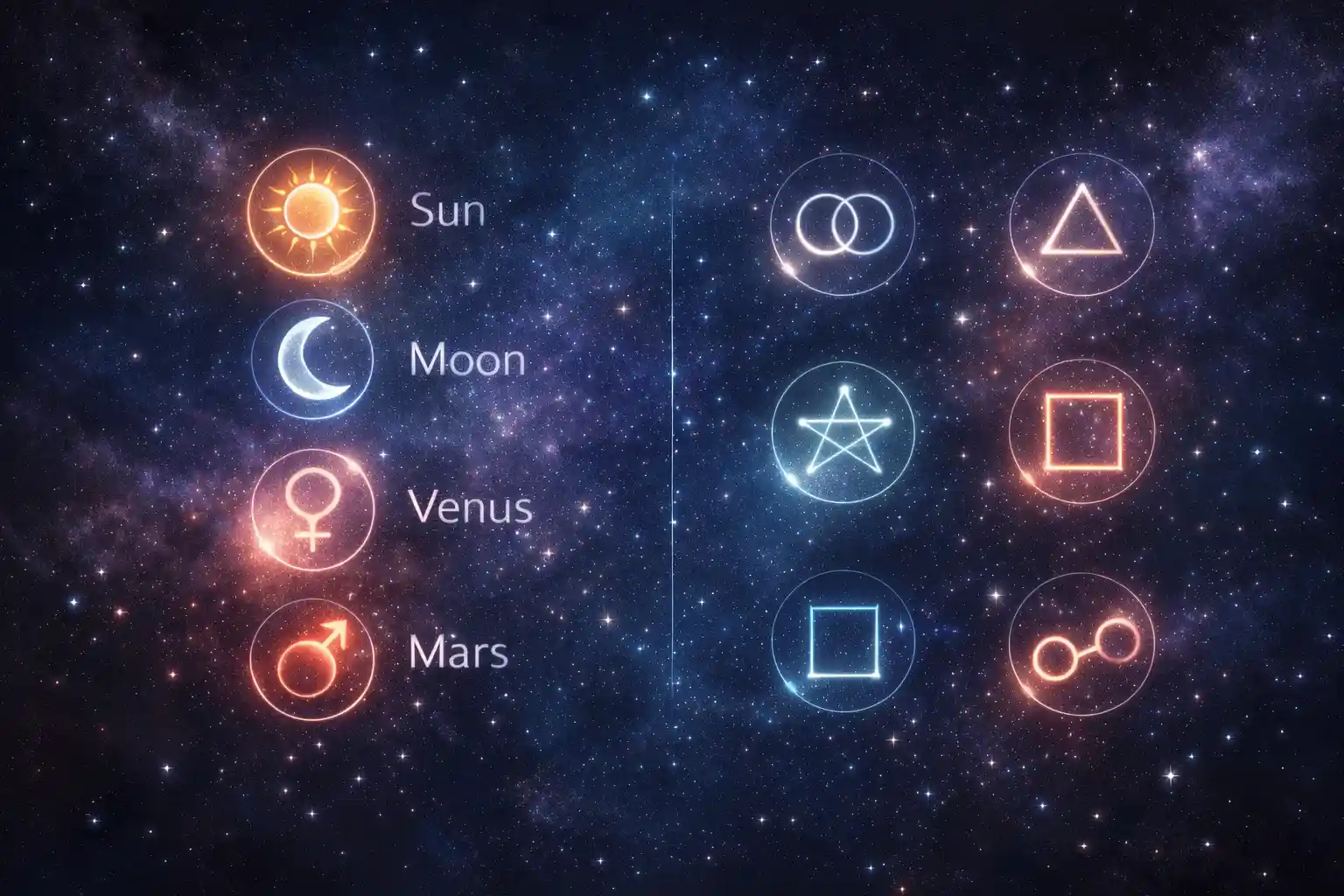
While every planet contributes to synastry, five planets carry the most weight when analyzing relationship compatibility. Understanding these planetary energies is the foundation of chart interpretation.
| Planet | Symbol | Rules | In Synastry |
|---|---|---|---|
| Sun | ☉ | Identity, Ego, Life Force | Core compatibility and mutual recognition |
| Moon | ☽ | Emotions, Needs, Comfort | Emotional understanding and nurturing |
| Venus | ♀ | Love, Beauty, Values | Romantic attraction and affection style |
| Mars | ♂ | Drive, Passion, Action | Physical chemistry and conflict style |
| Mercury | ☿ | Communication, Mind | Mental connection and dialogue flow |
When these planets form aspects between two charts, pay close attention. They represent the core dynamics that will shape your relationship experience.
The 5 Major Aspects Explained
Aspects are the angles formed between planets. Each aspect creates a different type of energy exchange—some flow easily while others create friction. Here are the five major aspects you'll encounter:
Conjunction (0°)
Planets merge their energies intensely. Can be harmonious or challenging depending on the planets involved. Creates powerful connection points.
Trine (120°)
Natural harmony and easy flow between planetary energies. Indicates areas where you naturally understand and support each other.
Sextile (60°)
Supportive and cooperative energy. Creates opportunities for growth and positive interaction with some effort.
Square (90°)
Dynamic tension that creates friction. Can lead to growth through challenge, but requires conscious effort to navigate.
Opposition (180°)
Polarizing energy that can create attraction or conflict. Offers opportunity for balance through integrating opposites.
An orb is the degree of deviation from an exact aspect. Tighter orbs (0-3°) indicate stronger influences, while wider orbs (5-8°) represent subtler effects. Our calculator automatically factors in orbs when analyzing your chart.
Step-by-Step: How to Read Your Chart
Now that you understand the basics, here's a systematic approach to reading your synastry chart:
Step 1: Study Each Birth Chart Individually
Before diving into synastry, understand each person's individual chart. Note their Sun, Moon, and Rising signs, as well as any dominant planetary patterns.
Step 2: Look for Sun-Moon Connections
Sun-Moon aspects are the backbone of emotional compatibility. Look for conjunctions, trines, or sextiles between one person's Sun and the other's Moon.
Step 3: Examine Venus-Mars Aspects
These aspects reveal romantic and physical chemistry. Venus-Mars conjunctions, trines, or oppositions often indicate strong attraction.
Step 4: Analyze House Overlays
Notice which houses your partner's planets fall into in your chart. Planets in the 1st, 5th, 7th, and 8th houses are particularly significant for relationships.
Step 5: Consider the Overall Pattern
Look at the balance of harmonious vs. challenging aspects. A healthy relationship usually has a mix of both—easy flow and areas for growth.
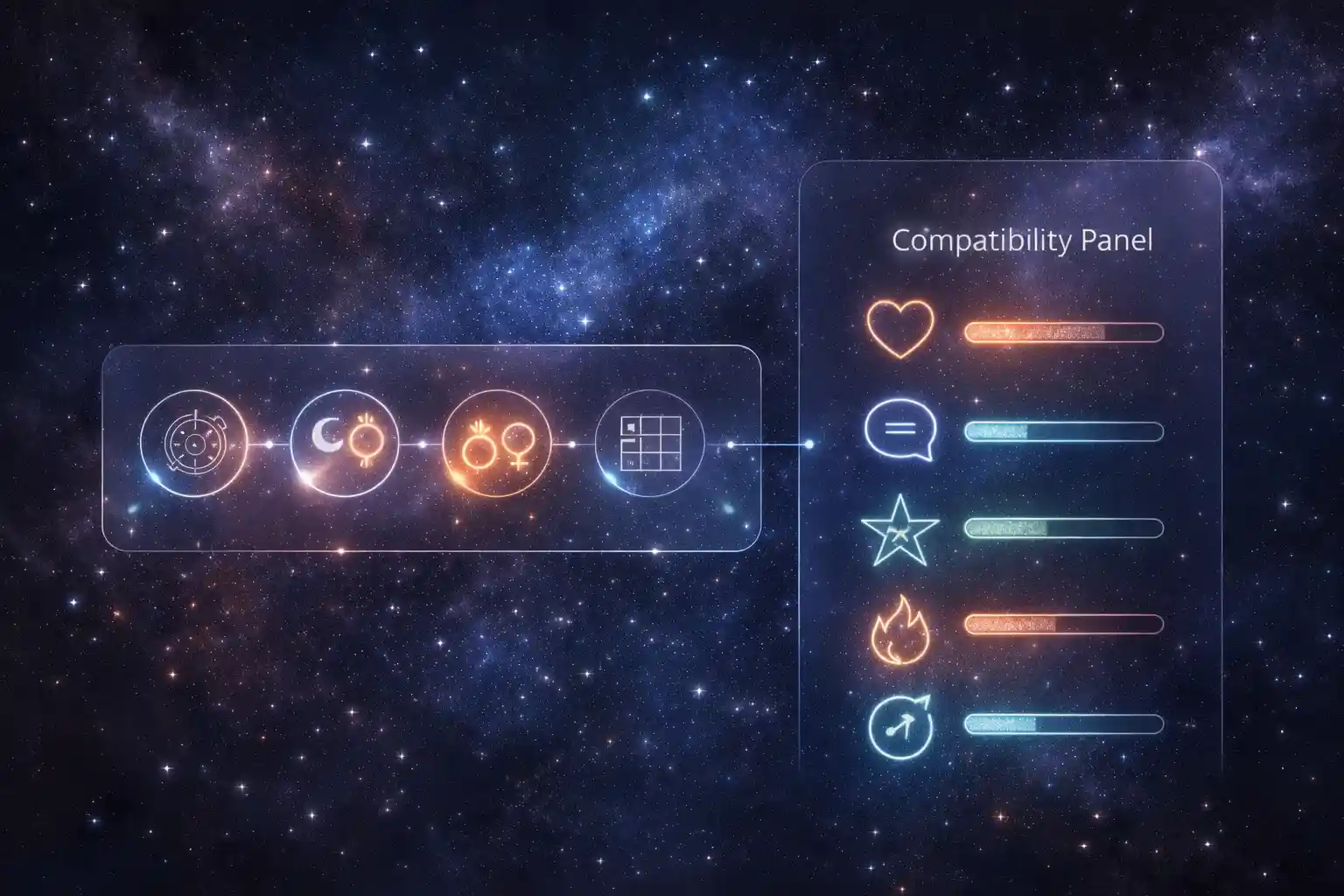
The 5 Dimensions of Compatibility
Our synastry calculator analyzes relationships across five key dimensions, giving you a comprehensive view of your compatibility:
- Emotional - Based on Moon aspects. Shows how well you understand each other's emotional needs and provide comfort.
- Communication - Based on Mercury aspects. Indicates how easily you exchange ideas and understand each other's thinking.
- Romantic - Based on Venus aspects. Reveals the level of affection, appreciation, and romantic harmony between you.
- Passion - Based on Mars aspects. Shows physical chemistry, drive, and how you handle conflicts together.
- Growth - Based on Jupiter and Saturn aspects. Indicates long-term potential and how you support each other's development.
Each dimension is calculated based on specific planetary aspects. A high score indicates natural harmony in that area, while a lower score suggests areas that may require more conscious effort and understanding.
Common Misconceptions
Before you start interpreting your chart, let's clear up some common myths about synastry:
Myth: "Challenging aspects mean a bad relationship."
Reality: Squares and oppositions create growth opportunities. Many strong, lasting relationships have significant challenging aspects—they keep things dynamic and push both partners to evolve.
Myth: "Perfect synastry guarantees relationship success."
Reality: Great synastry shows potential, not destiny. Free will, personal growth, and conscious choices matter just as much as cosmic compatibility.
Myth: "You need an exact birth time for any useful information."
Reality: While exact times give more detail, you can still gain valuable insights about Sun, Venus, Mars, and outer planet aspects without precise birth times.
Start Exploring Your Connections
You now have the foundation to begin reading synastry charts. Remember, astrology is a tool for self-awareness and understanding—not a definitive judgment on your relationships. Use these insights to foster better communication, appreciate your partner's unique qualities, and navigate challenges with greater awareness.
Create your free synastry chart now and discover the cosmic dynamics of your relationship. Calculate Your Synastry Chart
Disclaimer: Synastry and all astrological interpretations are for entertainment and self-reflection purposes only. They should not be used as the sole basis for relationship decisions. Always consider practical factors and use your own judgment.
Author

Categories
More Posts

Composite Chart vs Synastry Chart: Which Reveals More About Your Relationship?
Understand the difference between composite and synastry charts. Learn when to use each one, how to read them, and which relationship chart fits your situation.

Complete Guide to Reading Your Astrocartography Map
Learn how to read your astrocartography map and discover which locations around the world activate different planetary energies in your life.

Sun-Moon Connections: The Soul Mate Aspect in Synastry
Discover why Sun-Moon aspects are considered the ultimate soulmate connection in astrology. Learn about all six aspects and what they mean for your relationship.